Water Damage Restoration in Raleigh, NC
As the largest city in the Triangle, Raleigh holds a wide mix of single-family homes, apartments, retail spaces, and commercial buildings — each vulnerable to indoor water damage from plumbing failures, appliance leaks, storm intrusion, and flooding. Wake Forest Water Damage Restoration provides water extraction, structural drying, and cleanup for Raleigh properties from a base in neighboring Wake Forest.
Water Damage Problems We Handle in Raleigh, NC
Wake Forest Water Damage Restoration handles water damage in Raleigh caused by burst pipes, plumbing leaks, water heater failures, washing machine overflows, dishwasher and appliance leaks, toilet overflows, bathroom water damage, HVAC condensate problems, roof leaks, storm intrusion, indoor flooding, sewage backups, and commercial water losses. The type and source of water influence cleanup requirements.
Water damage in Raleigh rarely comes from one single cause. A supply-line failure can flood a hallway in minutes, while a slow condensate leak may release water behind a wall for days before it is noticed. Because water migrates into porous building materials — drywall, insulation, wood framing, subfloors, cabinetry, and baseboards — the visible wet area is often only part of the affected structure.
The source of the water matters. A clean supply-line leak, an overflow from a fixture, and water containing sewage each carry different contamination concerns, and cleanup follows the source. Contaminated water may require removal of affected porous materials, while a clean-water loss may focus more on extraction and drying. Each loss is evaluated on its own conditions rather than treated as identical to the last one.
Common Water Loss Scenarios
- Burst pipes and supply-line failures
- Plumbing leaks inside walls
- Water heater tank or connection leaks
- Washing machine hose and drain overflows
- Dishwasher and refrigerator line leaks
- Toilet overflows and bathroom water damage
- HVAC condensate drain overflows
- Roof leaks and ceiling water damage
- Storm and heavy rain water intrusion
- Indoor flooding and standing water
- Sewage backup and contaminated water
- Commercial water losses
How the Water Source Shapes Cleanup
Water losses are generally grouped by contamination level, and that grouping drives the cleanup approach in Raleigh. A clean-water loss — such as a fresh supply-line break or a filled tub overflow — is primarily an extraction and drying situation. Gray water from a washing machine, dishwasher, or aquarium overflow carries more contamination and may require more thorough cleaning of affected materials. Black water from a sewer backup or outside flood water can contain pathogens and often requires removal of porous materials that cannot be safely restored.
Because of those differences, the first priority on any Raleigh water loss is identifying what the water contacted and where it traveled. A clean-water leak that ran across a floor can still become a more serious situation if it sits long enough or reaches contaminated areas, so prompt extraction and drying remain important even when the water itself started clean.
If you are unsure what category of water you are dealing with, treat it cautiously. Avoid direct contact with water from a sewer backup or toilet backup, keep children and pets away from the affected area, and call for help rather than attempting to clean extensive contaminated water yourself.
Our Water Damage Restoration Process in Raleigh
The water damage restoration process in Raleigh follows a general sequence: assess affected areas, identify the apparent source, extract standing water, evaluate moisture migration, begin structural drying, use dehumidification where appropriate, clean and sanitize based on the water source, and determine restoration needs. Individual projects vary based on source, materials, contamination, and extent.
No two water losses unfold in exactly the same way. A burst pipe that floods a finished basement calls for different handling than a slow roof leak discovered through a ceiling stain. The process below is a framework, not a fixed checklist — each step is adjusted to the conditions found on site.
- 1
Assess Affected Areas
Identify the rooms and materials affected in your Raleigh property, including visible water and likely moisture migration paths.
- 2
Identify the Apparent Source
Determine where the water is coming from so the source can be addressed or isolated before drying begins.
- 3
Extract Standing Water
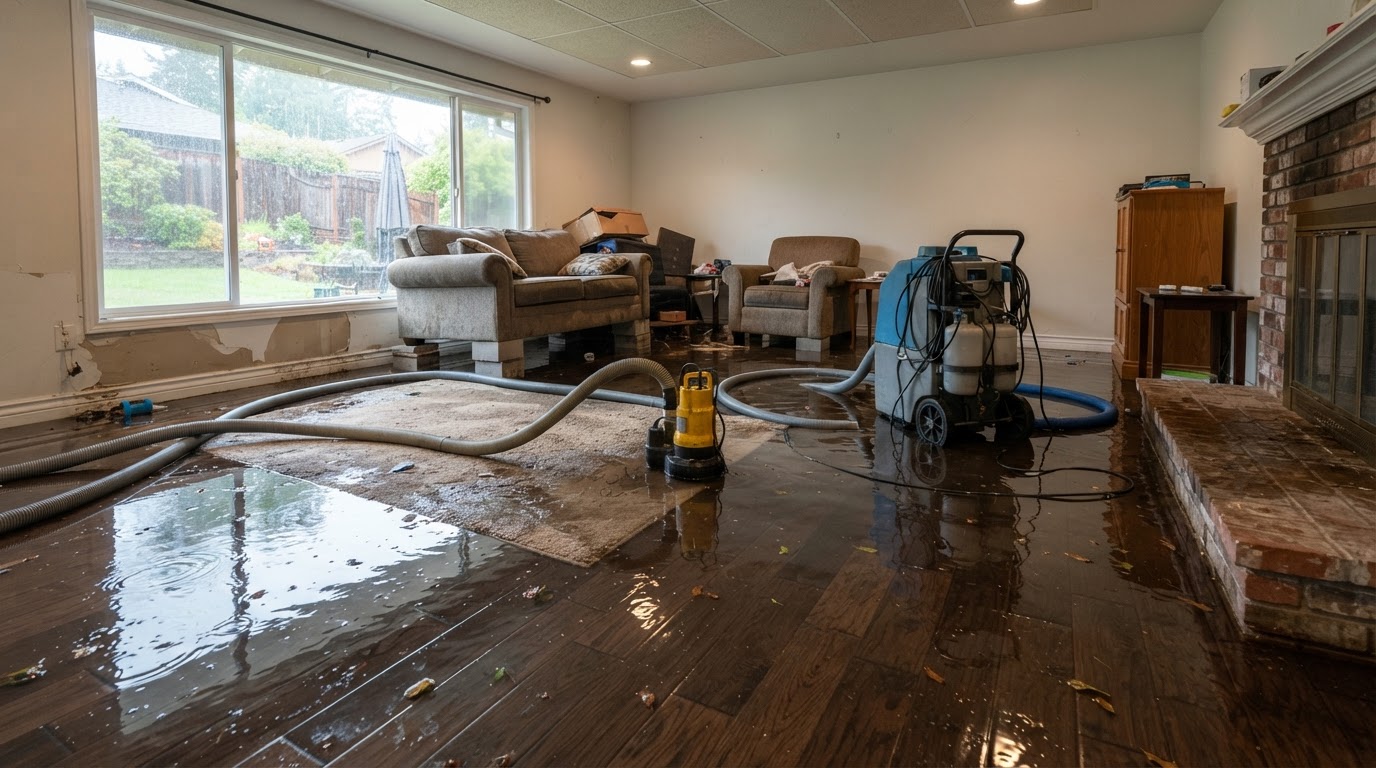
Remove pooled water using appropriate extraction equipment, including water that has collected beneath flooring or in low areas.
- 4
Evaluate Moisture Migration
Use moisture detection to check flooring, walls, ceilings, cabinetry, and other materials beyond the visibly wet area.
- 5
Begin Structural Drying
Use air movement and dehumidification to manage moisture retained inside building materials.
- 6
Clean & Sanitize Based on Source
Cleaning requirements depend on the contamination category of the water — clean water, gray water, or black water.
- 7
Determine Restoration Needs
Identify materials or areas that may require additional repair or restoration after drying is complete.
Water Extraction vs. Structural Drying
Water extraction removes visible standing water; structural drying manages the moisture that materials have already absorbed. Extraction comes first, but a room that looks dry on the surface can still hold moisture inside drywall, subfloors, and wall cavities. Both steps are needed to address the full extent of water damage in a Raleigh property.
Extraction uses specialized equipment to pull water off floors and out of carpet and padding before it can soak deeper into the structure. Drying then uses air movement and dehumidification to evaporate moisture out of materials that already absorbed it — wood framing, drywall, concrete subfloors, and cabinetry. The two steps work together: skipping drying leaves retained moisture behind even when the floor looks completely dry.
For property owners in Raleigh, understanding this difference matters because visible water is only part of the problem. Moisture that remains inside materials can lead to secondary property damage, which is why monitoring continues until materials reach an appropriate dry condition rather than stopping the moment the surface looks dry.
Standing Water in Your Raleigh Property?
Call now for water removal, moisture evaluation, and structural drying.
Water Damage Cleanup Services Near Raleigh
Wake Forest Water Damage Restoration offers 12 dedicated water damage cleanup services for Raleigh properties, covering emergency water removal, flood cleanup, sewage cleanup, burst pipes, storm damage, structural drying, commercial restoration, water heater leaks, washing machine overflows, bathroom water damage, HVAC and appliance leaks, and hidden water damage. Each service page provides detail on the specific water-loss scenario.
Where Water Damage Can Hide in Raleigh Homes & Buildings
Water can hide in drywall, wall cavities, ceilings, flooring, subfloors, cabinetry, baseboards, insulation, attics, crawl spaces, utility rooms, bathrooms, laundry rooms, and commercial ceiling and floor systems. Visible water can be removed while moisture remains inside porous materials, which is why moisture detection is used to check below the surface.
In Raleigh properties, the damage a leak causes often extends well beyond what is visible. Water follows gravity and the path of least resistance — running behind baseboards, under flooring transitions, into wall cavities, and through ceiling assemblies below upper-floor bathrooms or utility rooms. A small leak upstairs can produce a stained, softened ceiling downstairs while the upstairs floor still looks dry.
Removing standing water is only the first step. Drywall, insulation, and wood framing can hold moisture even after surfaces feel dry to the touch. Without drying those materials, persistent moisture can create conditions that support microbial growth and contribute to secondary property damage. Moisture meters and monitoring help determine whether materials have reached an appropriate dry condition.
Warning Signs to Watch For
- Water stains or discoloration
- Swelling or soft drywall
- Bubbling or peeling paint
- Warping or cupping flooring
- Persistent dampness or odors
- Wet flooring or condensation
- Elevated indoor humidity
- Water appearing far from the source
These signs may indicate moisture is present but do not by themselves prove a specific condition. A professional moisture assessment can confirm whether materials are still wet.
Residential & Commercial Water Damage Restoration in Raleigh
Wake Forest Water Damage Restoration provides residential and commercial water damage restoration in Raleigh for single-family homes, townhomes, apartments, rental properties, offices, retail spaces, professional buildings, and property-managed facilities. The same extraction, drying, and cleanup principles apply, scaled to the property and the loss.
Residential Water Damage
Kitchens, bathrooms, laundry rooms, living areas, attics, crawl spaces, and garages inRaleigh homes, townhomes, apartments, and rental properties. Water heaters, washing machines, toilets, and supply lines are frequent residential sources.
Residential losses in Raleigh range from a single overflowing toilet that affects one bathroom to a burst pipe that floods multiple rooms and travels between floors. In townhomes and apartments, water from an upstairs unit can damage the ceiling and belongings of the unit below, so affected areas are evaluated beyond the unit where the leak originated.
Landlords and rental property owners often need fast documentation of affected areas, and our process includes clear communication about what was wet and what drying steps followed. The goal is to return the living space to a dry, stable condition and plan any restoration work the loss requires.
Commercial Water Damage
Offices, retail spaces, professional buildings, rental portfolios, and multi-unit properties in Raleigh. Water can migrate between rooms and floors, and commercial carpet, ceiling systems, and built-in fixtures may all need drying.
Commercial losses often involve larger footprints and more complex materials — glue-down carpet, raised flooring, drop ceilings, and shared plumbing that serves multiple suites. A single pipe break above a Raleigh office can saturate ceiling tiles, insulation, and the carpet below across several rooms at once.
For property managers and business owners, coordinating around operations is part of the process. While no project can promise zero downtime, drying is staged to address the affected areas and help the business return to normal use as quickly as conditions allow.
Commercial water damage restorationWater Damage Help for Raleigh & Nearby Communities
Wake Forest Water Damage Restoration focuses on emergency response, water extraction and structural drying, multiple water-loss scenarios, residential and commercial service, a clear restoration process, local service-area focus, and easy phone contact for properties in Raleigh and the surrounding region.
Rather than a one-size-fits-all approach, each loss in Raleigh is evaluated on its own conditions — the water source, the materials affected, the contamination category, and how far moisture has migrated. That evaluation guides extraction and drying. Clear communication about affected areas and restoration steps helps property owners understand what is happening and what comes next.
Serving Raleigh From Wake Forest
The business is based in Wake Forest, NC, and provides service throughout Raleigh and the surrounding Triangle communities listed below. Each linked page provides service information for that area.
Water Damage Restoration FAQs for Raleigh, NC
Need Water Damage Help in Raleigh?
Call Wake Forest Water Damage Restoration for emergency water removal, water extraction, drying, flood cleanup, leak cleanup, and residential and commercial restoration in Raleigh, NC and nearby communities.
Wake Forest, NC 27587 • Serving Raleigh, NC & surrounding North Carolina communities